Showing posts with label historical. Show all posts

Monday, May 30, 2011

Pilar Hall Set for Repairs


PILAR, Bataan - After years in the drawing board, the long-overdue renovation of the municipal hall and historic giant flaming sword monument in front of it will push through with a R34-million budget, Mayor Charlie Pizarro revealed yesterday.

After the bid for the implementation of the two projects is published, their construction will be initiated immediately, said Pizarro. The mayor said Bataan Governor Enrique "Tet" Garcia and Rep. Abet S. Garcia (2nd District, Bataan) will also provide additional fund for the projects.


-by: Mar T. Supnad


source: http://www.bataan.gov.ph//index.php?option=com_content&task=view&id=466&Itemid=379

Wednesday, April 13, 2011

President Aquino hails 'unsung heroes


69 years after WW II, nation still thanking vets

PILAR, Bataan, Philippines—Tens of thousands of Filipino and American soldiers, both living and dead, were lauded by President Benigno Aquino III for their uncommon valor in Saturday’s commemoration of Araw ng Kagitingan at the World War II mountaintop shrine here.

Mr. Aquino said the Philippines would not be in a democracy now if not for the soldiers who put up a heroic resistance before succumbing to the superior force of the Japanese invaders in Bataan 69 years ago on Saturday.
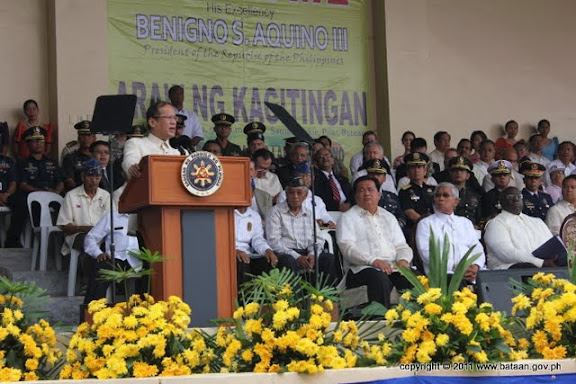
“I know that you, our veterans, may have lost some battles during those times, but your courage and love for country became instruments in winning a larger war—a war to awaken the Filipino heart, which allowed us to achieve independence,” he said in a speech.

A day after the Social Weather Stations announced that his late parents—former Sen. Benigno Aquino Jr. and former President Corazon Aquino—ranked behind Jose Rizal and Andres Bonifacio as the Filipinos’ “real heroes,” Mr. Aquino particularly paid tribute to those lacking in accolades.

“There are the named and the nameless. Today, we gather to pay tribute to our unsung heroes,” he said.

US Ambassador Harry Thomas and Japanese Ambassador Makoto Katsura delivered their own speeches at the Mt. Samat ceremony. Among the other Filipino officials present were Defense Secretary Voltaire Gazmin, Education Secretary Armin Luistro and top military officers.

War veterans and their families also participated in the event.

The President said that three generations after the war, the government was still trying its best to show its gratitude in terms of services for the vets and their families.

“More than seven decades after, we still remember your sacrifices,” he said, adding:

“Our generation has a lot to learn from our veterans. We would do well to emulate the spirit of service that they exhibited.

“Let us show that their sacrifices have not gone to waste.”

Mr. Aquino said the Philippine Veterans’ Memorial Medical Center had upgraded its operations with additional equipment and improvements in the operating room and intensive care unit.

“The Philippine Veterans’ Affairs Office (PVAO) has also ensured that there are more hospitals across the country where veterans and their families can receive an P800 daily subsidy for every day of confinement in the hospital,” he said.

Mr. Aquino reported that the Department of National Defense (DND) had allocated P1 million for the health insurance of qualified veterans under a memorandum of agreement between the PVAO and Philippine Health Insurance Corp. (PhilHealth).

He said the government had been monitoring the implementation in the Philippines of the Veterans Equity Compensation Act signed by US President Barack Obama in 2009 to make sure the benefits were received by the genuine veterans.

The law provides $9,000 to Filipino vets and $15,000 to those who had taken American citizenship.

About 8,000 vets have received the equity, Mr. Aquino said.

Ghost pensioners

The President also declared that the anomaly of “ghost pensioners” among the war vets had been put to rest.
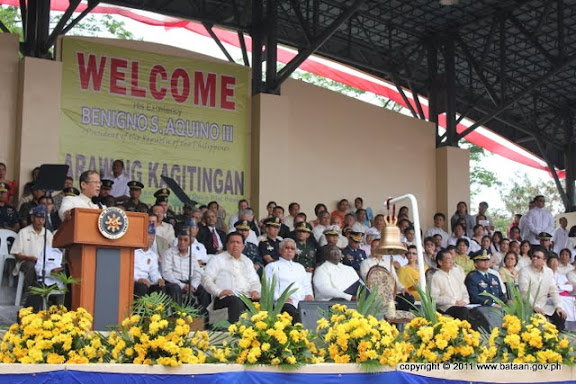
He said the systems put in place by the PVAO since 2008 had resulted in savings of P4 billion.

“Our latest news from the [DND] is that ghost pensioners are already part of history,” the President said.

“The funds have been returned and saved,” he said, adding that this had enabled the government to pay off 50 percent of debts to more or less 30,000 veterans.

The systems cited by the President include the Direct Remittance Pension Servicing System, which not only ensured fast and sure payment of pensions but also prevented those who failed to open bank accounts within a year from further receiving payments.

Then there are the Revalidation Program and the PVAO pensioners’ identification system that “further identified veterans that already died and that are no longer eligible to receive money.”

Best allies

The President cited the United States and Japan as the Philippines’ best allies after the war.

“I know that three generations ago, the three of us were in conflict. But since then, our country has had no greater friends than the United States and Japan,” he said.

Mr. Aquino said that Japan had been a partner toward economic progress as it provided the needed technology to cope with calamity, and that the United States shared with the Philippines “a long history of cooperation and mutual defense.”

“Time has proven that we can count on allies like them, and I am confident that they will stand by us should there be a threat again to our security and sovereignty and that they will support the path that we have taken toward transparency and progress,” he said.

With these partnerships, he said, he would continue efforts to stamp out corruption and poverty.

Mixed feelings

There were mixed feelings among the war vets after hearing the President’s speech.

“I should thank [Mr. Aquino] for showing care for us veterans. He has not forgotten our welfare. I hope he can really clean up the pension system of the PVAO,” said Constancio Serrano, 80.

A native of Plaridel, Bulacan, Serrano served in the Philippine Constabulary where he retired as a colonel.

But Roberto Gacayan, 84, of San Fernando City in La Union, was dismayed.

“I was waiting for him to say there would be an increase in our pension. We get only P5,000 a month, which is not enough for our everyday needs,” said Gacayan, who fought under the 121st Infantry Regiment of the Philippine Scouts.

But Gacayan said he was not complaining.

“I know the President is new on the job and he cannot instantly solve many concerns. But I’m happy the President came today. I think his coming shows that he cares for us,” Gacayan said.

Serrano and Gacayan were among some 500 soldiers, accompanied by their family members, who attended the Araw ng Kagitingan ceremony at Mt. Samat.

‘You’re still my boss’

While he did not promise a new package of benefits, Mr. Aquino vowed to ensure improved and additional services to the “unsung heroes.”

He urged the public to “emulate [the vets’] spirit of service” in the battle against the “new foes,” corruption and poverty.

“The sincerity will continue. Nothing will change. You are still my boss,” Mr. Aquino said.

He requested one thing from the veterans and their families: “I ask that we keep on helping each other and working for the benefit of all.” With a report from Tonette Orejas, Inquirer Central Luzo.


- Written by Norman Bordadora - Philippine Daily Inquirer


Wednesday, March 9, 2011

The Fall of Bataan (April 9, 1942)


While the Japanese already controlled Manila and other Luzon areas, the Filipino and American troops could not stop the Japanese advances.

On the month of February the Fil-American soldiers seems to lose their direction, with no food, no armaments. They are starving to death…How they can survive?

On the eleventh of March, Mc. Arthur left the Philippines…with his very well-known line, “I shall return!”.

On April 3, 1942, Lt. Gen. Masaharu Homma, commander of the Japanese Imperial Forces, ordered his men to attack and finally defeat the Filipino-American troops.

On April 6, 1942 the bloody battle begins at Mt. Samat. Hungry, disease-ridden, low on ammunition and without any hope of relief, the defenders of Bataan had no choice but to surrender to the Japanese on April 9, 1942.[i]

With supplies running out, and the army outnumbered and decimated by disease and starvation, decided to surrender rather than massacred by the Japanese invaders. The Army of Bataan completely collapsed.

What Bataan witnessed in those times, that it became home to tens of thousands of men and boys, fiercely defending freedom and the fatherland, will forever be etched into its history. The province’s name has since then been syno-nymous to courage, heroism and valor. It describes the strength and pride of a people who would choose suffering and death to foreign domination. When the end of battle came, on April 9, 1942, the words that were uttered and that echoed down the years were “Bataan has fallen”.[ii]

[i] Alberto S. Abeleda Jr., The Nation in Focus, St. Bernadette Publishing House Corporation, 2007, p. 119

[ii] Fr. Wilfredo C. Paguio, Bataan Land of Valor, People of Peace, Jardi Press, 1997, pp.105-106

Monday, March 7, 2011

The Land Called Bataan


The province known as Vatan during the Madjapahit Empire, was already a progressive settlement long before 1571. The Spaniards who first set foot on the land reportedly came upon a population of about 2,000.

The province of Bataan lies on the western coast of the island of Luzon, with an area of over 137,297 square hectares or a total of 1,243 square kilometers. It is bounded on the north by the province of Zambales; on the northeast, by the province of Pampanga; on the east, by Manila Bay; on the west, where its coastline forms a semicircle, by the China Sea; and on the South, by the canal between the verdant mountains of Mariveles and the historical fort-island of Corregidor called Boca-Chica.

In its northern part are the towns of Dinalupihan and Hermosa; in its eastern part, Orani, Samal, Abucay, Balanga, Pilar, Orion and Cabcaben; in its southern tip, facing Corregidor, the town of Mariveles; and in its south-western part, Bagac and Morong.

Bataan is blessed with more mountains than plains with a mountain found in each town of the province. It is ringed by a mountain chain called the Zambales mountains because they are located in that province, beginning from the highlands above Subic. A series of uplands stretches from Bataan’s southern tip, the highest of which is a peak called Mariveles. Mariveles is about 5,118 feet high or 13,390 meters above sea level, broken only between Balanga and bagac by a more or less extensive flat valley. A second range of uplands and plateaus rises above Orani forming the Butilao peak, with an altitude of approximately 4,751 feet. Other mountains are the Morro de Orion, Samal, Balanga, Dinalupihan and Mt. Samat in Pilar.

There is a notable difference between the eastern section of the province, which faces the bay, and the western section towards the China Sea. The first is, to a great extent, flat with gentle slopes of rising lands which present a beautiful view; while the second is very irregular.

Having some 20 leagues of coastline, Bataan keeps within its bosom, in the town of Orion, two-cabalitas of quagmire called lupang puti (white soil) by the natives; and a smaller one in Ogon, Balanga.

In Mariveles, Saysain, Bagac and Morong, there are small bays good for fishing. In Mt. Malasimbo, north of Dinalupihan, there are wells of water with gallionella ferrugia.

There are two deep and long rivers in this province, namely, Talisay and the Almacenes. Talisay, originating from the Samal and Orani mountains and branching out into Pilar and Balanga, forms the dividing line between these two latter towns. The Almacenes, welling from the mountains of Hermosa and coursing through the plains stretching to Subic, a part of Zambales, runs through the town of Dinalupihan and ends in the town of Lubao in the province of Pampanga.

This river also branches out to form the Cola and Lumaen rivers in Hermosa, and the sweet-watered Orani River which has a depth of about two to three arm-lengths and which passes through Lalawigan to the sea. It is named Almacenes because it is found in the place where, in olden times, timber and palms were brought together after being gathered from surrounding areas, and made to form launches which carried different commodities to the capital.

Other rivers are the Ogong in Balanga; Palivas, Balayang and Salinas in Abucay; and the river Calaguiman which passes through the town proper of Samal and the barrio of Mabatang where there was a big canal.

The average temperature in the province at midday through the months of November until February is 27° and 30° from March through June. The rest of the year has the same temperature due to the continued rains during these months. The atmospheric pressure, according to the reduced barometer, is usually 76,100 and in times of storms, reads as low as 71,500. Relative humidity during the rainy season is 80.0 to 90.0 and during the dry season, 60 to 70. Thunderstorms are frequent. And it is observed that atmospheric changes correspond to the two periodical monsoons of the year which are often not in any manner intense. Though sometimes the southwest monsoon caused cholera and the northwest monsoon coupled with intermittent heat could lead to pneumonia.

As a whole, however, the climate is temperature and the air is widely reputed to be pure and healthy.

The soil of the province presents different aspects and characteristics. In Mariveles and Abucay, it is sandy, clayish and plain, while in Hermosa it is plain. The soil of Orion is plain and sandy, and in Morong it is clayish; in Mabatang it is rocky, sandy, hilly and clayish; in Dinalupihan, plain and hilly; and in Bagac, clayish and plain.

The two highest mountains – Mariveles and Butilao – are not volcanic. They have neither lave nor slag, which proves that when the water appeared on top of the soil, it penetrated to where matter was boiling in a confused mixture, and the peaks of these two mountains rose to their present form.

This theory, according to Señor Azaola and as recorded by Father Vicente Fernandez, who kept extensive writings on Bataan, is proven by an examination of these same mountains. In their upper levels are found successive arches or basins (catanques) of water from the highest summit to the plains. This is a clear sign that when the mountains rose because of the liquefaction of igneous substances, depressions in the mountain tops were created when they cooled off, and, filled with water from the atmosphere, they broke the dikes which held them, because of their own weight and their descent to the plains, they formed others which, in their turn, were dug up, either by earthquakes or by the pressure of the water which had accumulated there.

That the soil is pyrogenic and of igneous eruption is proven by the fact that no signs or traces of any mineral have ever been found and only sulphates of iron, pirita marcial which they call guslagusla, are seen in certain rocks. The deposits of iron, titanite or sand, which are found in certain streams in Limay where there is a layer two felt deep, corroborate this hypothesis. For it is known that this mineral is most plentiful in all volcanic countries and is an element in the formation of the rocks in lands of igneous origin.

Notwithtstanding this, however, there are, in the break between Bagac and Morong, spheres or balls of greenish and black basalt, covered with a crust of marly siliceous layers which the people used as grinders, as well as basalt tabulanes doubtless underlying the rocks, which is not unusual in these formations.

This theory establishes the sufficient fertility of the soil of this province for agriculture. Actually, the lowlands from the north to the south are good for farming. Agustin Cavada records that by the year 1876, the land already cultivated over the whole province was about 3,768 hectares which was clayish-siliceous (siliceo-arcilloso) and with a muddy siliceous sub-soil.

Apart from the fertility of the soil, irrigation was never much of a problem. Because the mountain chains, which span an area of 125,000 hectares and where the soil is clayish-siliceous with a calcarious clayish-siliceous sub-soil, are provided with slopes on the east and west due to which the rivers follow a short course falling almost perpendicularly from the mountains into Manila Bay on the east and into China Sea on the west. With little effort, these streams and rivulets that empty into the sea from the mountains, were exploited for irrigation and the production of sugar by means of hydraulic machines.

Floods, a constant threat to agriculture-based provinces, were not frequent here due to the permeability of the soil and the regularity with which the forests conserve and distribute the rainfall.

Aside from its suitability to agriculture, Bataan is also rich in other natural resources. Abundant in lumber, it grows several varieties of trees which are useful for both civil and naval constructions. It also abounds in deer, wild boar, wild cats, alligators and sawa which is a delicacy of the Negritoes. Birds like doves, bato-bato, kingfishers, balores, calaos, white and green parrots and the balinsasayaw nest in its forests.

Between Orani and Hermosa, there is a place called la mina where bolinas pequeñas were found. These were said to be actually hierro hydratado de hierro pisiforme which were used by the natives for painting carriages and which can be properly studied and tapped for purposes of progress and development.

In Orani itself, there was a lagoon descending to a plain of clay used for making earthen jars (pilones) for the manufacture of sugar. In Samal, there is a deposit of dead shells (capiz) which is hitherto scientifically unexplained.

At the mouth of Morong River in Mariveles, there are hot spring called Balong-Anito with alcalinic water. It is also from here that the famous marmoles blancos de Mariveles come. Out of these, the statue of King Charles IV in one of the main thoroughfares of Manila and the pavement of the old Santo Domingo Church were made.

In a barrio of this town called San Miguel, there was a quarry. From the rocks taken there were constructed the Manila railway, the monument of Magellan in the isthmus of Santo Domingo and the baptismal fount of Balanga. In a cave at Pantogan, Orion, there are stones as brilliant as gold, which are classified as antimonio. Also, here can be found jade, which is very precious for the Chinese. Father Morales records that history refers to a Portuguese adventurer who found diamonds in the bosoms of its mountains in about the year 1620.

 
Design by Free WordPress Themes | Bloggerized by Lasantha - Premium Blogger Themes | Macys Printable Coupons