


 5:02 AM
 MIS Capitol Bataan

69 years after WW II, nation still thanking vets
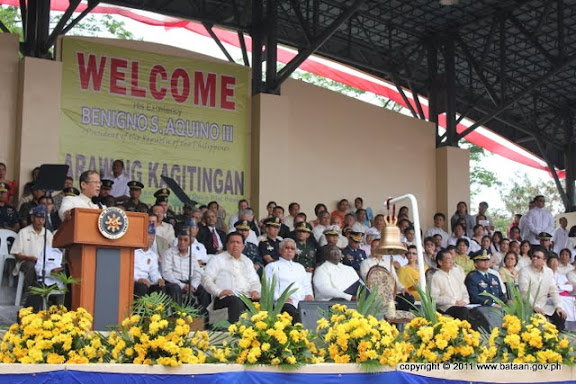
PILAR, Bataan, Philippines—Tens of thousands of Filipino and American soldiers, both living and dead, were lauded by President Benigno Aquino III for their uncommon valor in Saturday’s commemoration of Araw ng Kagitingan at the World War II mountaintop shrine here.
Mr. Aquino said the Philippines would not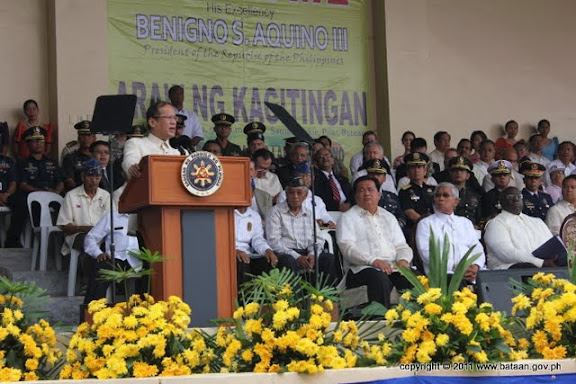 be in a democracy now if not for the soldiers who put up a heroic resistance before succumbing to the superior force of the Japanese invaders in Bataan 69 years ago on Saturday.
“I know that you, our veterans, may have lost some battles during those times, but your courage and love for country became instruments in winning a larger war—a war to awaken the Filipino heart, which allowed us to achieve independence,” he said in a speech.
A day after the Social Weather Stations announced that his late parents—former Sen. Benigno Aquino Jr. and former President Corazon Aquino—ranked behind Jose Rizal and Andres Bonifacio as the Filipinos’ “real heroes,” Mr. Aquino particularly paid tribute to those lacking in accolades.
“There are the named and the nameless. Today, we gather to pay tribute to our unsung heroes,” he said.
US Ambassador Harry Thomas and Japanese Ambassador Makoto Katsura delivered their own speeches at the Mt. Samat ceremony. Among the other Filipino officials present were Defense Secretary Voltaire Gazmin, Education Secretary Armin Luistro and top military officers.
War veterans and their families also participated in the event.
The President said that three generations after the war, the government was still trying its best to show its gratitude in terms of services for the vets and their families.
“More than seven decades after, we still remember your sacrifices,” he said, adding:
“Our generation has a lot to learn from our veterans. We would do well to emulate the spirit of service that they exhibited.
“Let us show that their sacrifices have not gone to waste.”
Mr. Aquino said the Philippine Veterans’ Memorial Medical Center had upgraded its operations with additional equipment and improvements in the operating room and intensive care unit.
“The Philippine Veterans’ Affairs Office (PVAO) has also ensured that there are more hospitals across the country where veterans and their families can receive an P800 daily subsidy for every day of confinement in the hospital,” he said.
Mr. Aquino reported that the Department of National Defense (DND) had allocated P1 million for the health insurance of qualified veterans under a memorandum of agreement between the PVAO and Philippine Health Insurance Corp. (PhilHealth).
He said the government had been monitoring the implementation in the Philippines of the Veterans Equity Compensation Act signed by US President Barack Obama in 2009 to make sure the benefits were received by the genuine veterans.
The law provides $9,000 to Filipino vets and $15,000 to those who had taken American citizenship.
About 8,000 vets have received the equity, Mr. Aquino said.
Ghost pensioners
The President also declared that the anomaly of “ghost pensioners” among the war vets had been put to rest.
He said the systems put in place by the PVAO since 2008 had resulted in savings of P4 billion.
“Our latest news from the [DND] is that ghost pensioners are already part of history,” the President said.
“The funds have been returned and saved,” he said, adding that this had enabled the government to pay off 50 percent of debts to more or less 30,000 veterans.
The systems cited by the President include the Direct Remittance Pension Servicing System, which not only ensured fast and sure payment of pensions but also prevented those who failed to open bank accounts within a year from further receiving payments.
Then there are the Revalidation Program and the PVAO pensioners’ identification system that “further identified veterans that already died and that are no longer eligible to receive money.”
Best allies
The President cited the United States and Japan as the Philippines’ best allies after the war.
“I know that three generations ago, the three of us were in conflict. But since then, our country has had no greater friends than the United States and Japan,” he said.
Mr. Aquino said that Japan had been a partner toward economic progress as it provided the needed technology to cope with calamity, and that the United States shared with the Philippines “a long history of cooperation and mutual defense.”
“Time has proven that we can count on allies like them, and I am confident that they will stand by us should there be a threat again to our security and sovereignty and that they will support the path that we have taken toward transparency and progress,” he said.
With these partnerships, he said, he would continue efforts to stamp out corruption and poverty.
Mixed feelings
There were mixed feelings among the war vets after hearing the President’s speech.
“I should thank [Mr. Aquino] for showing care for us veterans. He has not forgotten our welfare. I hope he can really clean up the pension system of the PVAO,” said Constancio Serrano, 80.
A native of Plaridel, Bulacan, Serrano served in the Philippine Constabulary where he retired as a colonel.
But Roberto Gacayan, 84, of San Fernando City in La Union, was dismayed.
“I was waiting for him to say there would be an increase in our pension. We get only P5,000 a month, which is not enough for our everyday needs,” said Gacayan, who fought under the 121st Infantry Regiment of the Philippine Scouts.
But Gacayan said he was not complaining.
“I know the President is new on the job and he cannot instantly solve many concerns. But I’m happy the President came today. I think his coming shows that he cares for us,” Gacayan said.
Serrano and Gacayan were among some 500 soldiers, accompanied by their family members, who attended the Araw ng Kagitingan ceremony at Mt. Samat.
‘You’re still my boss’
While he did not promise a new package of benefits, Mr. Aquino vowed to ensure improved and additional services to the “unsung heroes.”
He urged the public to “emulate [the vets’] spirit of service” in the battle against the “new foes,” corruption and poverty.
“The sincerity will continue. Nothing will change. You are still my boss,” Mr. Aquino said.
He requested one thing from the veterans and their families: “I ask that we keep on helping each other and working for the benefit of all.” With a report from Tonette Orejas, Inquirer Central Luzo.
- Written by Norman Bordadora - Philippine Daily Inquirer
PILAR, Bataan, Philippines—Tens of thousands of Filipino and American soldiers, both living and dead, were lauded by President Benigno Aquino III for their uncommon valor in Saturday’s commemoration of Araw ng Kagitingan at the World War II mountaintop shrine here.
Mr. Aquino said the Philippines would not
 be in a democracy now if not for the soldiers who put up a heroic resistance before succumbing to the superior force of the Japanese invaders in Bataan 69 years ago on Saturday.
“I know that you, our veterans, may have lost some battles during those times, but your courage and love for country became instruments in winning a larger war—a war to awaken the Filipino heart, which allowed us to achieve independence,” he said in a speech.
A day after the Social Weather Stations announced that his late parents—former Sen. Benigno Aquino Jr. and former President Corazon Aquino—ranked behind Jose Rizal and Andres Bonifacio as the Filipinos’ “real heroes,” Mr. Aquino particularly paid tribute to those lacking in accolades.
“There are the named and the nameless. Today, we gather to pay tribute to our unsung heroes,” he said.
US Ambassador Harry Thomas and Japanese Ambassador Makoto Katsura delivered their own speeches at the Mt. Samat ceremony. Among the other Filipino officials present were Defense Secretary Voltaire Gazmin, Education Secretary Armin Luistro and top military officers.
War veterans and their families also participated in the event.
The President said that three generations after the war, the government was still trying its best to show its gratitude in terms of services for the vets and their families.
“More than seven decades after, we still remember your sacrifices,” he said, adding:
“Our generation has a lot to learn from our veterans. We would do well to emulate the spirit of service that they exhibited.
“Let us show that their sacrifices have not gone to waste.”
Mr. Aquino said the Philippine Veterans’ Memorial Medical Center had upgraded its operations with additional equipment and improvements in the operating room and intensive care unit.
“The Philippine Veterans’ Affairs Office (PVAO) has also ensured that there are more hospitals across the country where veterans and their families can receive an P800 daily subsidy for every day of confinement in the hospital,” he said.
Mr. Aquino reported that the Department of National Defense (DND) had allocated P1 million for the health insurance of qualified veterans under a memorandum of agreement between the PVAO and Philippine Health Insurance Corp. (PhilHealth).
He said the government had been monitoring the implementation in the Philippines of the Veterans Equity Compensation Act signed by US President Barack Obama in 2009 to make sure the benefits were received by the genuine veterans.
The law provides $9,000 to Filipino vets and $15,000 to those who had taken American citizenship.
About 8,000 vets have received the equity, Mr. Aquino said.
Ghost pensioners
The President also declared that the anomaly of “ghost pensioners” among the war vets had been put to rest.
He said the systems put in place by the PVAO since 2008 had resulted in savings of P4 billion.
“Our latest news from the [DND] is that ghost pensioners are already part of history,” the President said.
“The funds have been returned and saved,” he said, adding that this had enabled the government to pay off 50 percent of debts to more or less 30,000 veterans.
The systems cited by the President include the Direct Remittance Pension Servicing System, which not only ensured fast and sure payment of pensions but also prevented those who failed to open bank accounts within a year from further receiving payments.
Then there are the Revalidation Program and the PVAO pensioners’ identification system that “further identified veterans that already died and that are no longer eligible to receive money.”
Best allies
The President cited the United States and Japan as the Philippines’ best allies after the war.
“I know that three generations ago, the three of us were in conflict. But since then, our country has had no greater friends than the United States and Japan,” he said.
Mr. Aquino said that Japan had been a partner toward economic progress as it provided the needed technology to cope with calamity, and that the United States shared with the Philippines “a long history of cooperation and mutual defense.”
“Time has proven that we can count on allies like them, and I am confident that they will stand by us should there be a threat again to our security and sovereignty and that they will support the path that we have taken toward transparency and progress,” he said.
With these partnerships, he said, he would continue efforts to stamp out corruption and poverty.
Mixed feelings
There were mixed feelings among the war vets after hearing the President’s speech.
“I should thank [Mr. Aquino] for showing care for us veterans. He has not forgotten our welfare. I hope he can really clean up the pension system of the PVAO,” said Constancio Serrano, 80.
A native of Plaridel, Bulacan, Serrano served in the Philippine Constabulary where he retired as a colonel.
But Roberto Gacayan, 84, of San Fernando City in La Union, was dismayed.
“I was waiting for him to say there would be an increase in our pension. We get only P5,000 a month, which is not enough for our everyday needs,” said Gacayan, who fought under the 121st Infantry Regiment of the Philippine Scouts.
But Gacayan said he was not complaining.
“I know the President is new on the job and he cannot instantly solve many concerns. But I’m happy the President came today. I think his coming shows that he cares for us,” Gacayan said.
Serrano and Gacayan were among some 500 soldiers, accompanied by their family members, who attended the Araw ng Kagitingan ceremony at Mt. Samat.
‘You’re still my boss’
While he did not promise a new package of benefits, Mr. Aquino vowed to ensure improved and additional services to the “unsung heroes.”
He urged the public to “emulate [the vets’] spirit of service” in the battle against the “new foes,” corruption and poverty.
“The sincerity will continue. Nothing will change. You are still my boss,” Mr. Aquino said.
He requested one thing from the veterans and their families: “I ask that we keep on helping each other and working for the benefit of all.” With a report from Tonette Orejas, Inquirer Central Luzo.
- Written by Norman Bordadora - Philippine Daily Inquirer
 Posted in:


